
The possibility of Manchester City going top of the Premier League with a win over Burnley FC—provided that victory comes by at least two goals—perfectly illustrates how fine the margins are in elite football. At this level, it’s not just about winning matches; it’s about how you win them, how many goals you score, and how effectively you limit your opponent. Every detail contributes to the bigger picture, and in a tight title race, those details can define an entire season.
To understand why a two-goal margin is so important, it’s essential to look at how the Premier League table is structured. Teams are ranked primarily by points: three for a win, one for a draw, and none for a loss. However, when two or more teams are level on points, the next deciding factor is goal difference. This is calculated by subtracting goals conceded from goals scored. If teams are still level after that, goals scored becomes the next tiebreaker.
In this particular scenario, Manchester City are assumed to be level on points with the team currently at the top of the table but slightly behind on goal difference. That means simply winning is not enough. A narrow 1–0 victory, while valuable in terms of points, may leave them still trailing on goal difference. However, a win by two goals or more would improve their goal difference sufficiently to leapfrog their rivals and claim the top spot.
This highlights a subtle but crucial aspect of modern football: teams are not only competing for points but also for statistical superiority. Managers and players are acutely aware of these dynamics, especially during the latter stages of the season. A late goal that turns a 1–0 win into a 2–0 victory can be just as important as the initial goal that secured the lead. In some cases, it can even be more significant, as it directly influences the standings.
For Manchester City, this kind of situation is not unfamiliar. Under their current philosophy, the team is built to dominate possession, create numerous chances, and score multiple goals in a single match. Their attacking depth allows them to maintain pressure on opponents throughout the game, which increases the likelihood of achieving the kind of winning margin needed in this scenario. Against a team like Burnley, who may adopt a more defensive approach, patience and precision become key.
Burnley, for their part, are not simply going to allow City to dictate the game without resistance. Teams facing Manchester City often set up with a compact defensive structure, aiming to limit space and frustrate their opponents. This can make it difficult to score early goals, which in turn increases the pressure on City as the match progresses. The longer the game remains close, the more challenging it becomes to achieve a multi-goal victory.
This is where game management comes into play. Manchester City must balance attacking ambition with defensive stability. While pushing forward in search of goals, they cannot afford to leave themselves exposed at the back. Conceding a goal would not only make the match more difficult to win but would also negatively impact their goal difference. For example, a 3–1 win still provides a +2 goal difference, but it requires scoring more goals to compensate for the one conceded. A clean sheet, on the other hand, simplifies the equation.
The psychological aspect of this situation is equally important. Knowing that a two-goal margin is required can influence the mindset of players. On one hand, it provides clarity: the objective is clear and measurable. On the other hand, it can create pressure, particularly if the team struggles to break through early on. Players may become anxious, rushing their decisions or forcing plays that would normally be executed with greater composure.
Experienced teams like Manchester City are typically well-equipped to handle this kind of pressure. Their players are accustomed to high-stakes matches and understand the importance of maintaining focus and discipline. Leadership on the pitch becomes crucial, as senior players help to keep the team organized and composed, even if the desired goals do not come immediately.
Another factor to consider is the timing of goals. An early goal can significantly change the dynamics of the match. If City were to score within the first 15 or 20 minutes, it would force Burnley to reconsider their approach. They might be compelled to push forward in search of an equalizer, which could create additional space for City to exploit. This, in turn, increases the likelihood of scoring a second goal and achieving the required margin.
Conversely, if the match remains goalless for a long period, Burnley’s confidence will grow, and City may find it increasingly difficult to break them down. In such situations, patience is essential. The breakthrough may come from a moment of individual brilliance, a set-piece, or a defensive error. Once the first goal is scored, the focus immediately shifts to finding the second.
Set-pieces can play a significant role in matches like this. Corners and free kicks provide opportunities to score even when open play is tightly contested. Manchester City’s ability to deliver accurate crosses and capitalize on these situations can be a decisive factor. Similarly, maintaining defensive discipline during Burnley’s set-pieces is crucial to avoid conceding.
Squad depth also becomes a key advantage. As the match progresses, fatigue can set in, particularly for the defending team. Manchester City’s ability to introduce fresh, high-quality players from the bench allows them to maintain intensity and creativity. Substitutes can bring a different dimension to the attack, potentially unlocking a stubborn defense and contributing to the goal tally.
The broader context of the season adds another layer of significance to this scenario. The Premier League is often decided by very small margins, and goal difference has historically played a decisive role in determining champions and final standings. Every goal scored and conceded throughout the season contributes to this cumulative statistic, making each match an opportunity to gain an edge.
For fans, situations like this add an extra level of excitement. It’s not just about whether the team wins, but by how much. Supporters may find themselves celebrating a second or third goal with even greater intensity, knowing its potential impact on the league table. Similarly, a late goal conceded can feel like a significant setback, even if the match is already won.
Media coverage and analysis often emphasize these nuances, highlighting the importance of goal difference and its potential impact on the title race. Pundits may discuss various scenarios, calculating how different results could affect the standings. This adds to the drama and anticipation surrounding the match.
From a tactical perspective, the approach taken by Manchester City will likely reflect their need for a convincing win. They may adopt an aggressive, high-pressing style, aiming to win the ball back quickly and sustain pressure on Burnley’s defense. Quick passing, movement off the ball, and positional fluidity are all key elements of their attacking strategy.
Burnley, meanwhile, may focus on defensive organization, attempting to limit space between the lines and force City into less dangerous areas of the pitch. Their objective will be to keep the scoreline as tight as possible for as long as possible, with the hope of either securing a draw or capitalizing on a rare opportunity to score.
Ultimately, the outcome of the match will depend on execution. Manchester City may create numerous chances, but converting those chances into goals is what matters. Efficiency in front of goal is crucial, as missed opportunities can prove costly in a scenario where goal difference is the deciding factor.
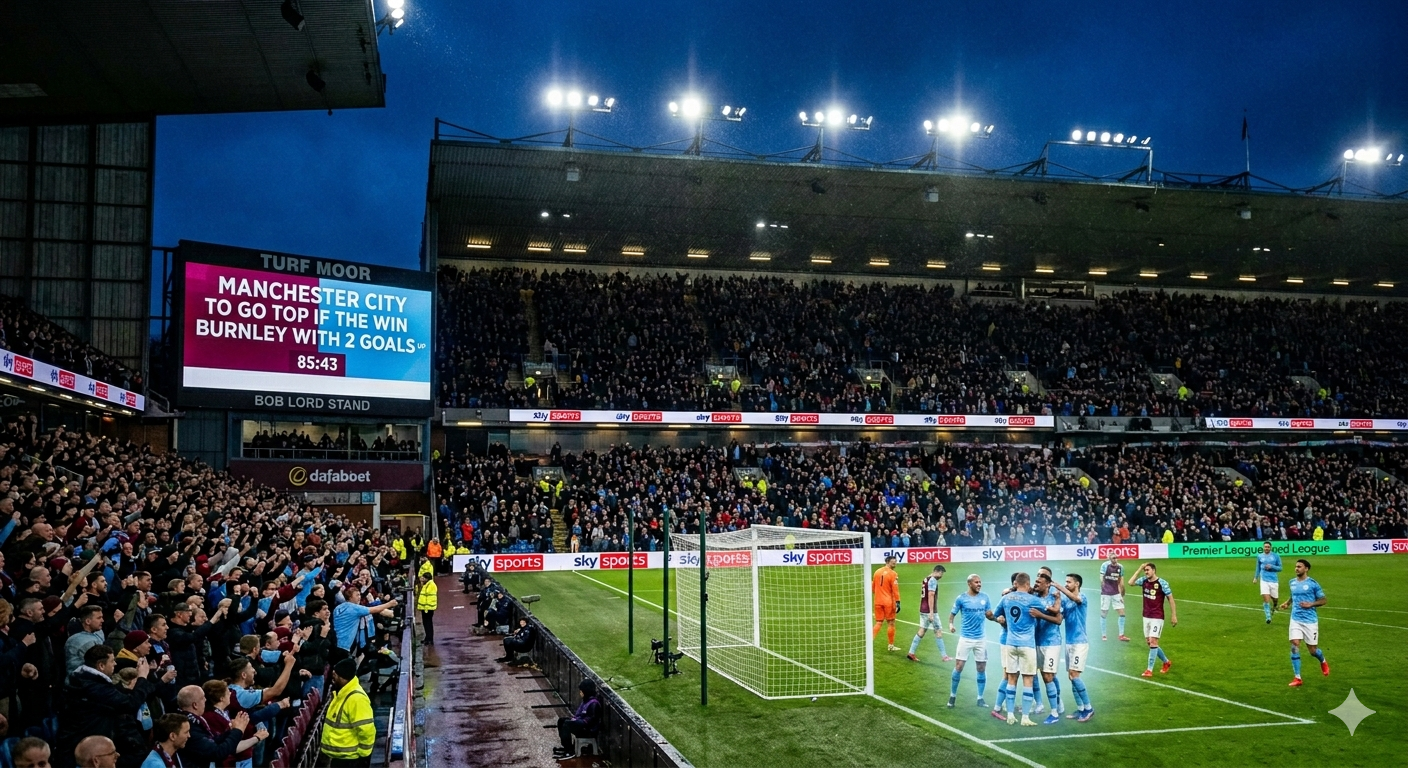
If City do manage to secure a two-goal victory, the reward is immediate and tangible: a place at the top of the Premier League table. This can provide a significant psychological boost, reinforcing their belief and putting pressure on their rivals. Being top of the table, even temporarily, can shift the momentum of the title race.
However, it’s important to recognize that this is just one match in a long season. While going top is a notable achievement, maintaining that position requires consistent performance over time. The same principles—winning matches, scoring goals, and maintaining a strong goal difference—will continue to apply in the games that follow.
In conclusion, the scenario in which Manchester City go top of the Premier League with a two-goal win over Burnley encapsulates the intricate balance of factors that define modern football. Points, goal difference, tactics, psychology, and execution all come together to shape the outcome. It serves as a reminder that success in football is rarely determined by a single moment, but rather by the accumulation of many small advantages over the course of a season.


