Introduction: An Unprecedented Intersect of Politics and Sport
The 2026 FIFA World Cup, set to be hosted jointly by the United States, Mexico, and Canada, has long been anticipated as a celebration of global unity. However, as the tournament approaches this summer, the geopolitical climate has placed an unexpected strain on the preparations. Amidst an ongoing conflict between the United States and Iran, diplomatic channels have recently been utilized in an extraordinary attempt to alter the tournament’s participant list.
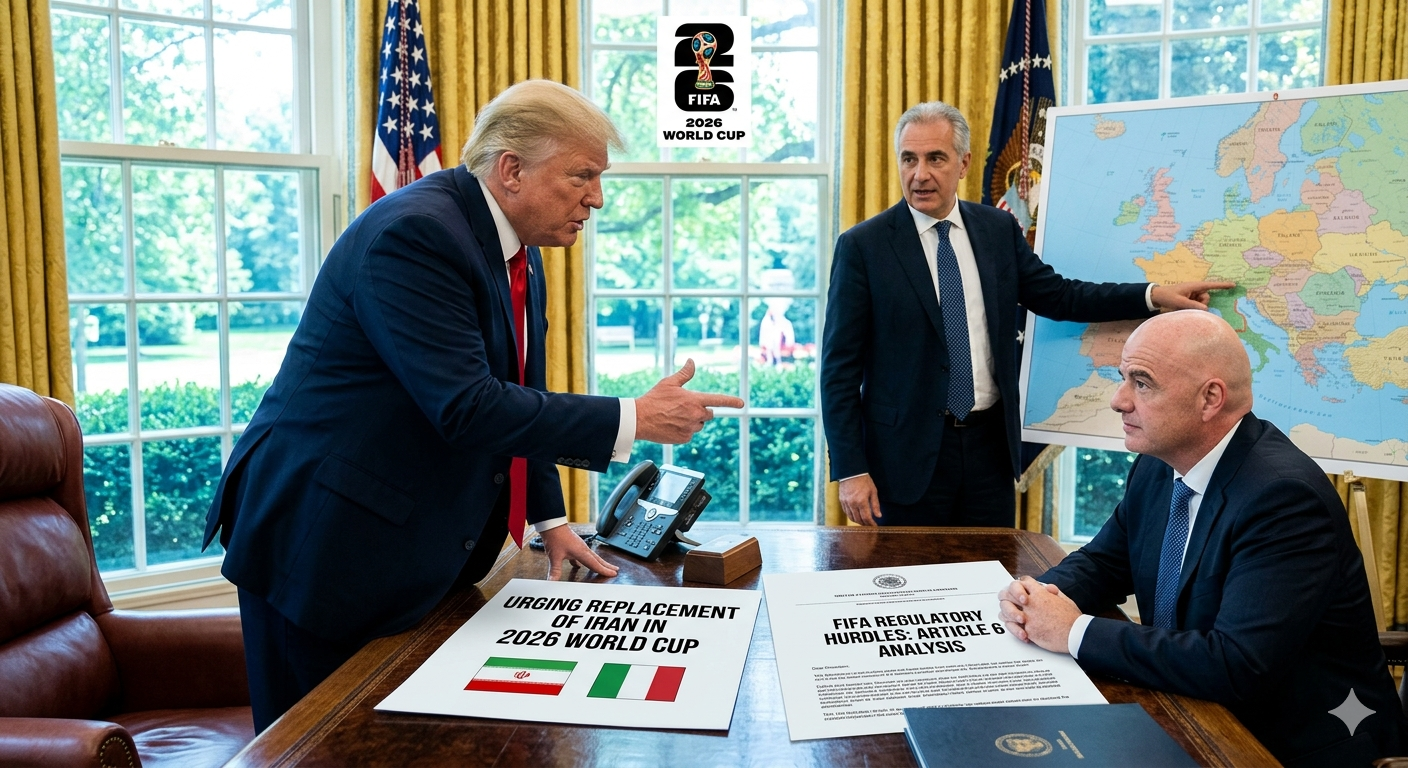
Reports have surfaced that a special envoy for U.S. President Donald Trump has formally suggested to FIFA that the Islamic Republic of Iran be removed from the tournament and replaced by Italy. While such a proposal is historically unprecedented in modern sporting history, it highlights the complex intersection of global politics and international athletics during one of the most volatile periods in recent memory. This report examines the origins of the proposal, the diplomatic friction driving it, and the significant regulatory hurdles that make such a substitution a highly improbable outcome.
The Genesis of the Proposal: A Diplomatic Gambit
The suggestion to replace Iran with Italy—a nation that failed to qualify through the traditional European qualifying process—originated from Paolo Zampolli, a U.S. special representative for global partnerships. The proposal, first reported by the Financial Times, is characterized not necessarily as a primary tactical move in the U.S.-Iran war, but rather as an instrument of “soft power” intended to mend fraying international alliances.
Relations between the United States and Italy, specifically between President Trump and Italian Prime Minister Giorgia Meloni, have reportedly reached a nadir in recent weeks. The friction traces back to President Trump’s public criticisms of Pope Leo XIV, whom the President attacked regarding the Vatican’s stance on the conflict with Iran. Prime Minister Meloni, whose government maintains strong ties to the Vatican and is a staunch advocate for European-led diplomatic initiatives, publicly characterized the President’s rhetoric as “unacceptable.”
In this atmosphere, the proposal to slot Italy into the World Cup is viewed by analysts as a calculated move by the Trump administration to reset the relationship. By granting Italy a coveted spot in the world’s most-watched sporting event, the administration would ostensibly be offering a massive diplomatic olive branch to Rome, potentially smoothing over the discord caused by the transatlantic spat over the Middle East.
The Sporting Context: Italy’s Absence and the “Azzurri” Factor
Italy, a four-time World Cup champion, has been absent from the tournament for three consecutive cycles, a drought that has been a source of national humiliation for the Italian public and football federation. After a devastating penalty-shootout loss to Bosnia and Herzegovina in a qualifying playoff final, the prospect of an Azzurri return to the global stage carries immense political and social weight.
Special Envoy Zampolli, himself an Italian native, justified the inclusion by citing the team’s “pedigree” and historical significance to the sport. From a marketing perspective, the inclusion of Italy—a country with a massive global fanbase—would undoubtedly be a financial boon for the tournament organizers and broadcasters. However, from a sporting integrity standpoint, the proposal faces immediate and significant criticism. Critics argue that rewarding a team that failed to qualify on the pitch would undermine the very meritocracy that FIFA purports to uphold.
The FIFA Regulatory Hurdle: Article 6 and the Precedent of Exclusion
Any change to the 32-team (or expanded) tournament lineup is governed strictly by FIFA regulations. Article 6 of the 2026 World Cup regulations provides the legal framework for participant withdrawal and replacement. Specifically, regulation 6.5 states that if a participating member association withdraws, or if a match cannot be played due to force majeure, the FIFA organizing body holds the authority to decide on the matter at its sole discretion.
Regulation 6.7 further empowers FIFA to replace a removed association with another. However, the operative word is “discretion.” FIFA has historically maintained a strict policy of neutrality, attempting to insulate the tournament from the political currents of host nations.
FIFA President Gianni Infantino has consistently resisted efforts to politicize the tournament. Despite the ongoing war and significant U.S. pressure regarding the security and participation of the Iranian team, Infantino has been unequivocal. “The Iranian team is coming, for sure,” Infantino stated during a recent forum in Washington, D.C. He emphasized that the players represent their people, not the government, and that the tournament’s purpose is to “bring people together.”
The “Life and Safety” Argument: A Shifting Narrative
The administration’s argument for removing Iran has shifted from purely security-based concerns to one of “life and safety.” President Trump has stated on social media platforms that while the team might be “welcome,” he does not believe their participation is “appropriate” given the security environment in the United States and the ongoing conflict.
This framing is designed to suggest that removing Iran is an act of protection rather than an act of political punishment. Nevertheless, the move is widely viewed by international observers as a continuation of the administration’s broader campaign to isolate the Iranian regime. For the Iranian government, the participation of its national football team in the United States is a point of national pride and a platform for international visibility. Their sports minister has already signaled that the team is prepared to play, regardless of the political posturing.
Broader Implications: The Burden of Hosting
The situation underscores the profound challenges of hosting a global event during a time of war. The United States, as a primary host, is in a precarious position. The role of a host nation typically involves ensuring the safety and freedom of movement for all participating delegations, regardless of diplomatic relations. Using the World Cup as a lever in foreign policy risks setting a precedent that could destabilize future tournaments.
If the U.S. government were to successfully force a team out, it would effectively signal to the world that hosting rights are contingent upon the political whims of the host nation. This could lead to a fragmentation of FIFA’s authority, with future host nations feeling empowered to pick and choose participants based on their own geopolitical agendas. Such an outcome would fundamentally alter the nature of the World Cup, transforming it from a global festival of sport into a controlled instrument of statecraft.
Conclusion: The Unlikelihood of the Shift
Despite the high-level lobbying by the U.S. envoy and the clear political motivation behind the proposal, the reality remains that FIFA is highly unlikely to replace Iran with Italy. The logistical, legal, and reputational costs of such a move would be catastrophic for the governing body. FIFA relies on the stability of its qualifying structures; to bypass them for political expediency would trigger widespread outcry from other nations and potentially lead to a cascade of protests and lawsuits.
As of late April 2026, the Iranian team continues its preparations, and the tournament organizers in the U.S. are moving forward with the assumption that all qualified nations will take the field. While the report of the proposal has created a flurry of news coverage and intense debate in diplomatic circles, the “Azzurri” appearing in the 2026 World Cup—at least through the mechanism of replacing Iran—remains a scenario firmly rooted in political maneuvering rather than sporting reality.