
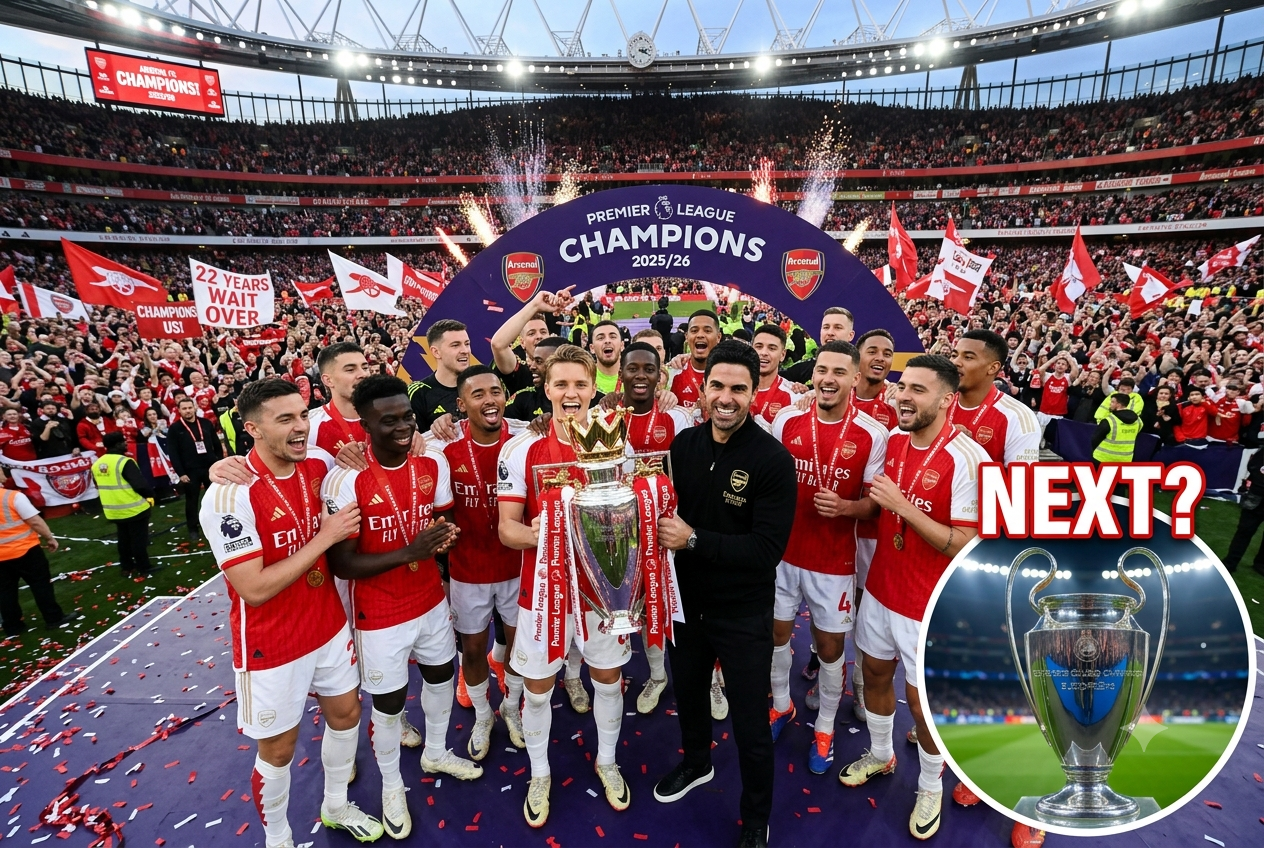
Champions of England
How Arsenal Shattered a 22-Year Drought to Reclaim the Premier League Trophy
The 22-year-old ghost of the 2003/04 “Invincibles” has finally been laid to rest. In May 2026, Arsenal Football Club completed one of the most agonizing, resilient, and ultimately triumphant journeys in modern sporting history by securing the 2025/26 Premier League title.
For more than two decades, the red side of North London existed in a state of perpetual longing. Generation after generation of supporters grew up on the mythical tales of Patrick Vieira, Thierry Henry, and Arsène Wenger lifting a golden trophy without losing a single match. Since that historic 2004 campaign, the club endured a grueling stadium move, the twilight and departure of their greatest manager, years of financial austerity, a painful fall from the UEFA Champions League elite, and the crushing psychological weight of finishing as runners-up for three consecutive seasons.
But under the meticulous guidance of Mikel Arteta, the bridesmaids finally became the bride. Following a hard-fought 1-0 victory against Burnley at the Emirates Stadium, the title was mathematically sealed the very next evening without Arsenal even lifting a boot. Manchester City’s dramatic 1-1 draw against Bournemouth left the reigning champions four points behind with only one match remaining. The long wait was over. Arsenal were the Kings of England once more.
The Pain of the Past: Three Years of Heartbreak
To understand the magnitude of Arsenal’s 2025/26 triumph, one must understand the scar tissue that preceded it. This was not a sudden, unexpected Leicester City-style fairytale; it was the culmination of brutal, incremental growth bought with tears and heartbreak. For three consecutive seasons, Arsenal had pushed Manchester City to the absolute limit, only to falter in the final straight.
Critics labeled them “bottlers.” Media pundits openly questioned whether this specific core of players, led by captain Martin Ødegaard, possessed the psychological fortitude to outlast Pep Guardiola’s ruthless, state-backed winning machine. Each near-miss felt heavier than the last. Yet, instead of fracturing under the weight of public cynicism, Arteta and his squad utilized the pain as fuel. The recruitment strategy became sharper, the tactical foundations became more rigid, and the collective skin of the squad grew impenetrably thick.
A Campaign Rooted in Defensive Absolute
While the 2004 Invincibles were defined by fluid, devastating attacking arrogance, the Class of 2026 conquered England through an unrelenting, suffocating defensive structural elite. Anchored by the world-class central partnership of William Saliba and Gabriel Magalhães, Arsenal turned the penalty box into a fortress.
Supported by the tireless, tactical intelligence of Declan Rice in midfield and the immense left-sided presence of Riccardo Calafiori, the Gunners strangled games with historic regularity. Behind them stood David Raya, who secured his third consecutive Premier League Golden Glove award by keeping an astonishing 19 clean sheets across the campaign. Arsenal did not just win matches; they systematically denied their opponents the oxygen required to compete. Conceding a mere 26 goals over the course of 37 matches, they established a defensive benchmark that ground down the rest of the league.
“We had to build a wall. In this league, if you give an inch, teams like Manchester City will take a mile. The boys didn’t just defend; they lived for the clean sheet. That is why we are standing here today as champions.”
The Pivotal Moments: How the Title Was Won
The season began with an implicit statement of intent: a grueling, statement-making 1-0 victory against Manchester United at Old Trafford. It kicked off a blistering run of form that saw the Gunners claim victory in nine of their opening ten matches. By October, Arsenal had seized control of the league table—a position they would fiercely maintain for over 200 days.
However, a Premier League title is never won without a crisis. In April, the familiar anxieties of the past threatened to boil over. A narrow, exhausting 2-1 defeat to Manchester City at the Etihad Stadium allowed Guardiola’s side to temporarily leapfrog the Gunners on goal difference. The collective footballing world braced for another Arsenal collapse.
Instead, the response was immaculate. Showing the emotional maturity of a seasoned championship team, Arsenal reeled off four consecutive victories without conceding a single goal. They dismantled local rivals Tottenham Hotspur 4-1 on their own turf, ground out a tactical 1-0 win against Brighton, shutout Everton 2-0, and completed the job at home against Burnley via a crucial 36th-minute strike from Kai Havertz. When Manchester City stumbled at the Vitality Stadium against Andoni Iraola’s spirited Bournemouth side, the mathematical reality set in. The title belonged to N5.
The Architecture of Arteta and the Core
This championship serves as the ultimate validation for Mikel Arteta. Taking over a fractured, identity-less club in December 2019, the Spaniard endured immense pressure, calls for his sacking, and intense scrutiny over his strict cultural demands. By clearing out overpaid superstars and building a culture around young, hungry, and technically proficient profiles, he built a self-sustaining ecosystem of excellence.
On the pitch, his vision was brought to life by an elite leadership core. Martin Ødegaard operated as the side’s creative heartbeat, dictating tempos and leading the high press with unmatched work rate. On the right wing, homegrown superstar Bukayo Saka continued his ascension into world-class status, routinely delivering clutch goals and assists under double-coverage. The versatile Kai Havertz emerged as the ultimate big-game focal point, silencing doubters by scoring the championship-clinching goal against Burnley.
A Greater Destiny Awaits
As thousands of euphoric Arsenal fans spilled into the streets surrounding the Emirates Stadium, marching through the night with red flares and timeless chants, the realization of what this team achieved began to set in. They didn’t just win a trophy; they lifted a generation-defining psychological block.
Yet, the most frightening prospect for the rest of Europe is that Arsenal’s story for the 2025/26 season is not entirely written. While the final league match against Crystal Palace at Selhurst Park will serve as a glorious coronation and trophy presentation, an even grander stage awaits. On May 30, 2026, Arsenal will fly to Budapest to face Paris Saint-Germain in the UEFA Champions League final. Boasting an unbeaten record in Europe this season, Mikel Arteta’s relentless machine stands on the precipice of a historic continental double—a feat that would undeniably crown this specific squad as the greatest to ever wear the iconic cannon on their chest.
The 22-year drought is over. The future, entirely unburdened by the past, belongs exclusively to Arsenal.


