
10 Things to Know About Football
A Comprehensive Historical Journey from 1930 to 2026

The Global Game Through the Decades
Association football—commonly known as soccer in some parts of the world and simply football to billions globally—has evolved from an elite regional pastime into the world’s most consumed cultural phenomenon. Spanning nearly a century from the modest inception of the FIFA World Cup in 1930 to the modern landscape of 2026, the sport has witnessed massive shifts in tactics, technology, global economics, and societal impact.
This extensive retrospective breaks down the 10 most crucial historical turning points, developmental phases, and structural revolutions that have defined football over the last 96 years.
1. The Genesis: The Inaugural 1930 World Cup in Uruguay
The history of modern international football officially crystallized in July 1930 when Uruguay hosted and won the very first FIFA World Cup. At the time, global travel was cumbersome and expensive, meaning only 13 teams participated—all by invitation rather than qualification. Long ocean voyages deterred many European nations, with only four making the grueling trek across the Atlantic.
Despite these logistical challenges, the tournament was an organizational success and set the stage for a new global sporting tradition. The final match saw hosts Uruguay defeat Argentina 4–2 at the newly constructed Estadio Centenario in Montevideo, establishing South America as an early powerhouse of the global game.

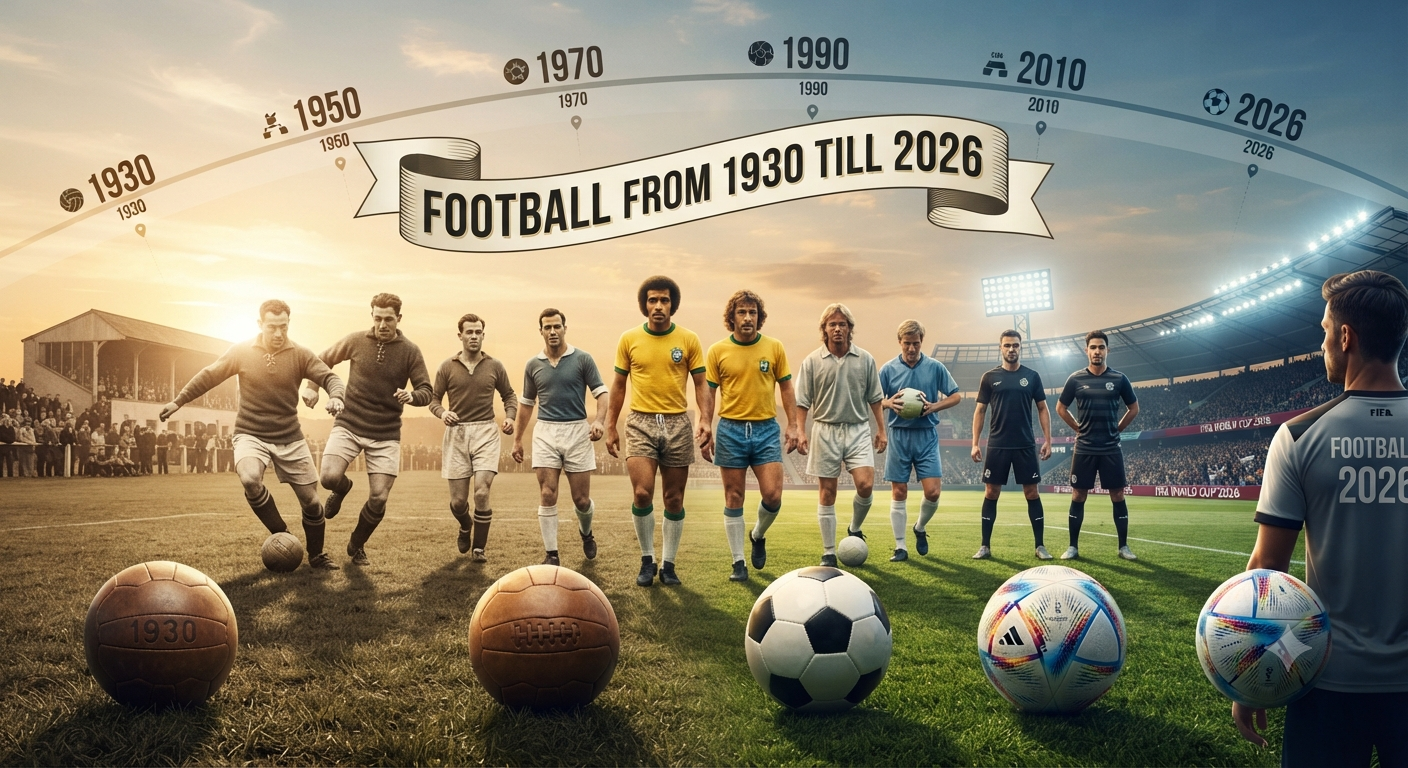
This foundational era was characterized by amateurism and rudimentary equipment. Players wore heavy leather boots with steel toes, wool jerseys, and leather balls that became dangerously heavy when wet due to the lace-up valve system. Yet, the tactical frameworks—such as the classic Pyramid (2-3-5) formation—laid the groundwork for modern strategic analysis.
2. The Post-War Renaissance and Tactical Evolution (1950s)
After a 12-year hiatus enforced by World War II, the World Cup returned in 1950 with Brazil hosting. The tournament produced one of the most stunning upsets in sports history—the “Maracanazo”—where Uruguay defeated the heavily favored Brazilian hosts 2–1 in front of a record-breaking crowd estimated at nearly 200,000 spectators.
The 1950s also marked a profound tactical revolution led by the legendary Hungarian “Mighty Magyars” team, featuring Ferenc Puskás. Hungary discarded rigid traditional positions in favor of fluid movement, deep-lying center-forwards, and positional interchange. Their resounding 6–3 victory over England at Wembley Stadium in 1953 shattered the myth of English tactical superiority and signaled that European and global football was entering a sophisticated modern tactical era.
3. The Pelé Phenomenon and the Golden Age of Brazil (1958–1970)
No single individual shaped the global imagination of football in the mid-20th century quite like Edson Arantes do Nascimento—better known as Pelé. Bursting onto the world stage as a 17-year-old prodigy at the 1958 World Cup in Sweden, Pelé led Brazil to their first-ever global triumph with breathtaking skill, athleticism, and goalscoring instinct.
Brazil’s triumphs in 1958, 1962, and a historic third victory in 1970 cemented their status as masters of the “Joga Bonito” (the beautiful game). The 1970 Brazil side, featuring Pelé, Jairzinho, Carlos Alberto, and Rivelino, is widely regarded by historians as the greatest attacking team in international football history, showcasing a brand of expressive, joyous, and technically flawless football.

This era also witnessed the birth of continental club competitions, most notably the European Cup (now the UEFA Champions League) inaugurated in 1955. Real Madrid dominated this era, capturing five consecutive titles led by Alfredo Di Stéfano and Ferenc Puskás, establishing European club football as a powerhouse of talent and wealth.
4. Total Football and the Scientific Revolution (1970s)
If Brazil defined the expressive art of football in 1970, the Netherlands and Ajax redefined its scientific execution in the early 1970s. Pioneered by coach Rinus Michels and orchestrated on the pitch by Johan Cruyff, “Total Football” revolutionized tactical theory.
The core philosophy of Total Football was simple yet demanding: any outfield player could take over the role of any other player dynamically during active play. If a defender moved forward to attack, a midfielder or forward would seamlessly drop into the vacant defensive slot. This demanded extraordinary aerobic fitness, technical versatility, and tactical intelligence. Although the Dutch national team finished as runners-up in the 1974 and 1978 World Cups, their tactical DNA permanently altered how modern managers construct and train teams.
5. Commercialization, Television, and the Bosman Ruling (1990s)
The closing decade of the 20th century transformed football from a regional working-class sport into a multi-billion-dollar global entertainment industry. The formation of the English Premier League in 1992, driven by massive television broadcast rights deals with Sky Sports, created a financial model that would soon be replicated globally.
Simultaneously, the landmark 1995 European Court of Justice ruling—known as the **Bosman Ruling**—fundamentally restructured player contracts and transfer markets in Europe. It allowed professional footballers within the European Union to move freely to another club at the end of their contracts without a transfer fee, while dismantling long-standing restrictions on foreign players. This catalyzed the rise of hyper-resourced super-clubs and laid the groundwork for modern player empowerment and international squads.
6. The Globalization of Tactics and the Tiki-Taka Era (2000s–2010s)
As the new millennium unfolded, the tactical pendulum swung between defensive discipline—typified by Italian *Catenaccio* derivations and José Mourinho’s pragmatic counter-attacking blocks—and hyper-possession dominance. The peak of the latter arrived with Pep Guardiola’s Barcelona team and the Spanish national team of 2008–2012.
Utilizing “Tiki-Taka”—a style characterized by short, intricate passing, relentless high-pressing off the ball, and positional supremacy—Spain captured back-to-back European Championships (2008, 2012) and sandwiched a historic first World Cup victory in South Africa (2010). This era also showcased the unprecedented individual rivalry between Lionel Messi and Cristiano Ronaldo, who pushed each other to unprecedented scoring records and individual accolades across two decades.
7. Technological Integration: VAR, Goal-Line Tech, and Semi-Automated Offsides
For over a century, football was famously plagued by controversial refereeing errors—such as Geoff Hurst’s disputed goal in the 1966 World Cup final or Diego Maradona’s “Hand of God” in 1986. Resistance to technology finally crumbled in the 21st century as television replay standards made human refereeing blind spots glaringly obvious.
The introduction of Goal-Line Technology (GLT) in the early 2010s ensured absolute accuracy for whether a ball crossed the line. This was swiftly followed by Video Assistant Referees (VAR) ahead of the 2018 World Cup in Russia, and later, Semi-Automated Offside Technology (SAOT). While debated fiercely by purists regarding the flow and emotional spontaneity of the game, technology drastically reduced clear refereeing errors in elite professional competitions.
8. The Rise of Women’s Football on the Global Stage
While men’s football dominated historical archives for decades, the exponential growth of women’s football stands as one of the most defining sports narratives of the late 20th and early 21st centuries. Following decades of official bans or systemic neglect in major footballing nations, the inaugural FIFA Women’s World Cup took place in 1991 in China.
Tournaments such as the 1999 Women’s World Cup in the United States—memorably capped by Brandi Chastain’s iconic penalty shootout celebration—demonstrated massive commercial and cultural viability. Entering the 2020s, participation numbers, professional leagues, broadcasting rights, and stadium attendances exploded globally, drawing record-breaking crowds in Europe, North and South America, and Asia.
9. Financial Super-Leagues, State Ownership, and Multi-Club Networks
By the mid-2020s, the economic landscape of elite football had shifted dramatically. Traditional club ownership models relying on local ticket sales and modest sponsorships were largely replaced by sovereign wealth funds, billionaire conglomerates, and private equity firms.
Clubs backed by nation-states or global investment groups pioneered the “multi-club ownership” model, acquiring teams across different continents to streamline player scouting, development, and financial resource sharing. Simultaneously, attempts by elite clubs to form breakaway European Super Leagues sparked fierce regulatory battles with UEFA, FIFA, and passionate fan bases, highlighting an ongoing cultural tension between the corporate globalization of the sport and its deep community roots.
10. The Modern Era in 2026: Expanded Horizons and Data Analytics
As football reaches the present day in 2026, the sport continues to expand its boundaries. The historic men’s World Cup hosted across North America (United States, Canada, and Mexico) introduces an expanded 48-team format, reflecting the truly global reach of the sport and offering new nations an opportunity on the grandest stage.
Furthermore, modern football is entirely saturated by advanced data analytics. Artificial intelligence, wearable GPS tracking vests, expected goals (xG) metrics, and tactical tracking cameras analyze every single touch, sprint, and passing lane in real-time. From its humble origins with leather lace-up balls in 1930 to the hyper-connected, data-driven spectacle of 2026, football remains a universal language connecting billions of people worldwide.