
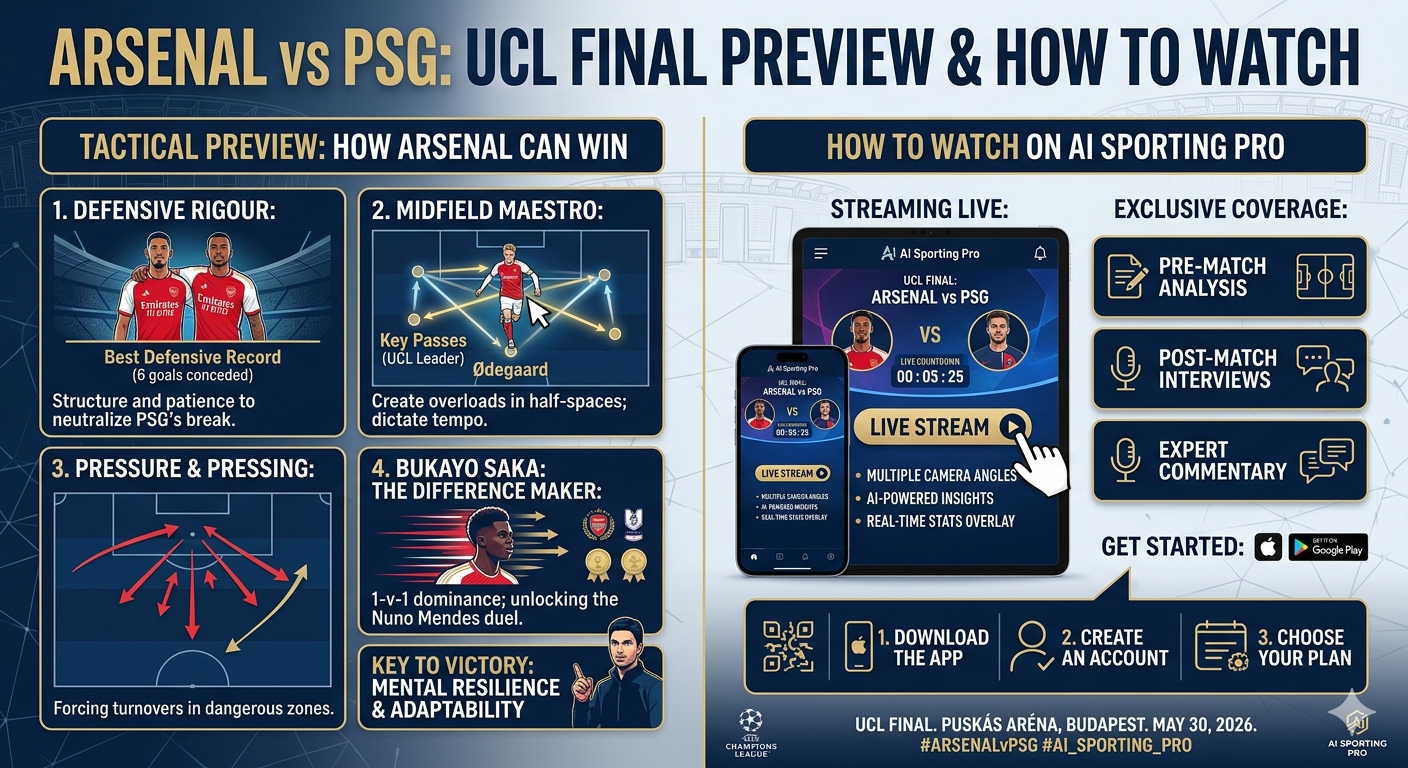
The 2026 final at the Puskás Aréna represents far more than a football match—it is a defining moment between two contrasting footballing philosophies.
As Arsenal FC and Paris Saint-Germain prepare to meet on May 30, the narrative is layered with history and ambition. For Arsenal, it is a pursuit to finally secure their first European crown. For PSG, it is an opportunity to reinforce their status as a dominant force in modern football.
Despite PSG entering as defending champions, tactical, psychological, and statistical indicators position Arsenal as slight favorites.
Tactical Foundations of an Arsenal Advantage
Defensive Structure and Stability
Under Mikel Arteta, Arsenal has evolved into one of Europe’s most complete teams. Their defensive pairing of William Saliba and Gabriel Magalhães has been central to their success.
- Average xG conceded (knockout stage): 0.65
- High defensive line with minimal vulnerability to counter-attacks
- Strong aerial and positional discipline
This structure will be critical in neutralizing the pace of Ousmane Dembélé.
👍 Follow Us on FacebookMidfield Control and Pressing Efficiency
The midfield trio led by Declan Rice and Martin Ødegaard provides balance between defensive coverage and creative output.
Key strengths include:
- High-intensity pressing in advanced areas
- Efficient ball recovery leading to quick transitions
- Tactical spacing to exploit PSG’s midfield gaps
PSG’s midfield—featuring Vitinha and Warren Zaïre-Emery—may struggle under sustained pressure.
Key Matchup: Individual Battles
Bukayo Saka vs Nuno Mendes
This duel is likely to shape the outcome of the final.
- Saka’s ability to cut inside creates scoring and assist opportunities
- Mendes’ overlapping runs are crucial to PSG’s width
- If Saka pins Mendes defensively, PSG’s attacking structure becomes limited
Tactical Fluidity in Attack
Arsenal’s rotating forward system—featuring Kai Havertz and Gabriel Jesus—introduces unpredictability.
This movement forces PSG defenders like Marquinhos into constant decision-making under pressure, increasing the likelihood of defensive lapses.
Match Logistics
- Fixture: Arsenal vs PSG
- Date: May 30, 2026
- Kick-off: 21:00 CET
- Venue: Puskás Aréna, Budapest
- Capacity: 67,215 (Sold out expected)
Financial Overview
- UEFA Prize (Final): ~€20 million
- Estimated Total Earnings: €130+ million
- Potential Bonus Pool (Arsenal): £45 million (if domestic + European double achieved)
Psychological Edge
PSG carries the expectations of defending champions, which can introduce pressure in high-stakes moments.
Arsenal, by contrast, enters with:
- A “project culmination” mindset
- Strong internal leadership (e.g., Jorginho)
- Momentum built over multiple seasons
This psychological positioning may prove decisive in tight phases of the match.
Fan Influence & Atmosphere
Arsenal supporters are expected to dominate neutral allocations, potentially creating a “home-like” atmosphere in Budapest.
The emotional energy generated by traveling fans could provide a measurable performance boost in critical moments.
Statistical Outlook
- Win Probability (90 mins):
- Arsenal: 42%
- PSG: 38%
- Draw: 20%
- Predicted Scoreline: Arsenal 2–1 PSG
- Likely Goalscorers:
- Saka (Arsenal)
- Ødegaard (Arsenal)
- Khvicha Kvaratskhelia (PSG)
Final Assessment
Arsenal’s advantage lies in systemic cohesion rather than reliance on individual brilliance.
Key differentiators:
- Superior defensive organization
- Efficient pressing system
- Elite set-piece execution
- Tactical adaptability
In high-pressure finals, structured systems often outperform individual talent—and Arsenal exemplifies that principle.
Conclusion
All indicators suggest that Arsenal is positioned to secure their first UEFA Champions League title. If they execute their tactical plan effectively, the trophy is likely heading to North London.


